Masten Manor Assault and Susan Norton Hanging
'Salem's Lot: A NovelThe raid on the Marsten House and Susan Norton’s staking marks the point at which the vampire threat becomes an immediate moral and physical ordeal for the surviving investigators. The house is not merely a hiding place: it dominates Jerusalem’s Lot from its hill above the crossroads, commands an almost complete view of the township, and carries the taint of both murder and suicide. The assault therefore joins an investigation of supernatural violence to a return into the town’s oldest remembered shame.
The House as a Site of Accumulated Violence
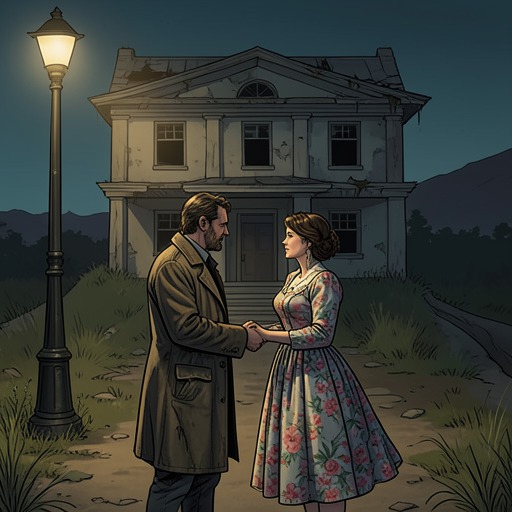
Father Donald Callahan sees the Marsten House from the Brooks Road and suddenly understands its physical power. Its elevation makes it loom over Jerusalem’s Lot, while its closed shutters turn the huge, rambling building into a sarcophaguslike mass associated with doom. The place stands on what he regards as unhallowed ground because Hubert Marsten murdered Birdie Marsten there before taking his own life. The town has preserved that history across generations, even though many of its details have been lost or distorted.
That partial memory is characteristic of Jerusalem’s Lot. The town was incorporated in 1765 and later celebrated its bicentennial with fireworks and a park pageant, yet its civic history coexists with buried violence that ordinary public rituals cannot absorb. The Marsten scandal had occurred before the living residents were born, but small-town memory transmitted it ceremonially, making the house a structure in which historical recollection and supernatural dread reinforce each other.
The Assault and Straker’s Corpse
Ben Mears insists that the group enter through the front door, breaking it down if necessary. Father Callahan, who had once expected hesitation or compromise from himself, instead advances with an eagerness that feels imposed upon him. The house seems to exude evil through its cracked paint, and his movement toward it becomes less a deliberate decision than an irresistible summons.
At the entrance, Father Callahan raises the authority of his priesthood and commands the evil to leave the house. When he strikes the door with his crucifix, the act produces a visible flash, a sharp smell of ozone, and a crackling noise like the building itself crying out. The fanlight bursts outward, the bay window empties its glass onto the lawn, and the new Yale lock is welded into an unrecognizable lump. The threshold thus becomes the first battlefield of the raid: a mundane security device is destroyed by a religious object acting as a weapon.
The investigators search upstairs before turning fully to the lower rooms. At the end of the hall, Ben confronts a repetition of his childhood terror, expecting the room to contain Hubert Marsten or his ghost. Instead, the body is Richard Straker. Straker has been suspended upside down like a slaughtered pig, his throat ripped open, his eyes fixed beyond the intruders, and his body drained completely of blood. His death confirms that the violence within the house has exceeded its earlier human history; even the vampire’s servant has become disposable within the machinery of the outbreak.
Susan Norton’s Staking and the Crisis of Recognition
The raid’s most intimate horror occurs away from the house’s monumental exterior, when Susan Norton’s condition must be determined rather than assumed. Ben Mears resists the conclusion that she is dead, but Jimmy Cody has already tested her body: the blood-pressure cuff registers 00/00, and the stethoscope finds no heartbeat. The distinction is therefore not rhetorical. Susan’s stillness conceals an undead condition, and the investigators must recognize that the woman they knew cannot be treated as an ordinary corpse.
The decision becomes a test of knowledge, loyalty, and action. Ben presses the stake against Susan’s left breast, just above the last button of her blouse, while fear turns the simple baseball bat into an object of unnerving weight. His hesitation preserves the emotional identity of the woman before him; Jimmy’s insistence forces him to confront the altered state confirmed by medical examination. The scene’s value shifts from attempted preservation to necessary destruction, because leaving Susan intact would allow the vampire infection to continue through her body.
Father Callahan frames the act within a language of burden and passage, invoking the principle that bitter waters must be crossed before sweetness can be reached. Ben asks for divine forgiveness and drives the hammer down. The stake enters Susan’s heart, and the physical response exposes the violence hidden beneath her apparent passivity: her eyes open, blood surges over Ben, her hands strike at the air, and fangs appear as she releases repeated shrieks. Her transformation is not a private tragedy alone; it provides direct, terrifying confirmation that the town’s dead can return as active predators.
The aftermath is deliberately practical and secretive. Father Callahan and Jimmy place Susan’s body facedown in a crate from the cellar, perhaps the same kind of container in which Barlow entered town, fill it with stones, and throw it into the Royal River. They use Straker’s car so that anyone who notices the disposal near the bridge will associate it with Straker rather than with the surviving investigators. This concealment does not undo the staking or restore Susan’s identity; it shows how the vampire crisis has forced the group to combine religious ritual, medical evidence, physical violence, and improvised criminal procedure.
Consequences for the Investigation
The raid transforms the Marsten House from an ominous historical landmark into a demonstrable center of the vampire crisis. The destruction at the entrance shows that the house can resist ordinary access yet respond violently to religious authority, while Richard Straker’s corpse reveals that allegiance to the supernatural offers no security even to its human agent. Susan Norton’s staking establishes an equally consequential fact on the personal scale: vampirism has not merely killed members of Jerusalem’s Lot but has converted someone intimately known to the investigators into an active undead threat. Her measured blood pressure of 00/00 and the silent examination by stethoscope give the group empirical confirmation, but the convulsions, fangs, blood, and shrieks make that confirmation impossible to keep at the level of clinical theory. The investigators are consequently driven beyond observation into irreversible acts of containment. Susan’s body is weighted and cast into the Royal River in a cellar crate, with Richard Straker’s car used to divert suspicion, an expedient that underscores how completely the emergency has blurred the boundaries between investigation, burial, and concealment.
The House Within the Town’s Memory
The episode also enlarges the meaning of the house by placing its present violence against the town’s layered historical record. Jerusalem’s Lot had been incorporated in 1765 and could publicly celebrate its bicentennial with fireworks and a park pageant, yet its civic continuity rests beside memories of murder, suicide, disappearance, and rumor. The Marsten House is the most concentrated version of that contradiction. Its crime predates the current generation, but the community preserves it through repeated recollection, even while lacking the knowledge to explain what actually occurred there. The same pattern governs the town’s other secrets: residents know fragments of domestic violence and unexplained child disappearances, while the causes remain buried beneath incomplete testimony. During the raid, this inherited uncertainty acquires physical proof. The house is no longer only a story passed between generations; it becomes the place where a body is found drained of blood, a sacred object destroys a lock, and a beloved woman is revealed as undead. Its power lies in the convergence of architecture, memory, and recurrence: the old crimes have not remained past events but have become the emotional and supernatural conditions through which new violence enters Jerusalem’s Lot.
Historical Recurrence and Narrative Significance
The raid acquires its fullest significance when set beside the town’s older records of concealed violence. The disappearance of four children between 1928 and 1939 had left no bodies and no explanation, while the history of Hubert Marsten and Birdie Marsten survived as a communal fragment stripped of its most disturbing details. The same pattern extends further back: Robert Boone’s recovered diary records a 1789 descent into obsession surrounding Jerusalem’s Lot, a desecrated church, and a dangerous book, although later accounts question the reliability of Charles Boone’s papers and attribute his final violence to recurring brain fever. Against this background, the assault on the Marsten House is not an isolated incursion but a moment in which rumor, suppressed testimony, and supernatural recurrence become materially legible. The house gathers the town’s habit of forgetting into one charged location, while Susan Norton’s staking forces the investigators to acknowledge that the past is no longer merely remembered: it is acting in the present.